UX Research & Usability Testing
Prosoon - 3/3
Credentials, Job Seeking
UX Research, Interviews & Usability Testing
February 2026
Due to its scope, this project is split into three case studies. This academic +140-page group project received high marks (18/20 and 20/20).
Overview
Prosoon‘s company provides digital verifiable credentials and badges to showcase and attest the success of the users academic studies and professional training. It also offers a job board as a main feature.
Prosoon facilitates connections between three key audiences:
Institutions: Uploading authentic digital badges and degrees.
Employers: Publishing job offers.
Students & Job Seekers: Showcasing their skills, ensuring they are verifiable and support their job search.
Our goal was both to understand the needs of students and Job seekers and to evaluate the usability of the interface.
For this academic project within a team of five, I was one of the two main contributors.
My missions were as follows: running a competitor analysis and an expert review, writing and running the usability test, moderating an interview, recruiting participants, analyzing and creating the visuals for the data and contributing to writing the report.
Goals
By conducting interviews, we aimed to understand the users’ goals, needs and pain points, while creating their resumes, gathering their credentials and sending their applications. The goal was to provide students and job seekers with a tool that is perfectly tailored to their needs. We also conducted a Quantitative analysis and Usability tests to validate the pain points identified during the expert review and the heuristic evaluation.
Research
This part of the research was conducted as a team.
- Each member interviewed one participant. It gave us insights to create Personas, using Job to Be Done and How Might We, which guided our feature decisions and future design.
- We created a Quantitative survey in French and English to gather data from a larger audience and identify patterns in how people handle their resumes and credentials. We posted it on social media, forums, and shared it with different faculties.
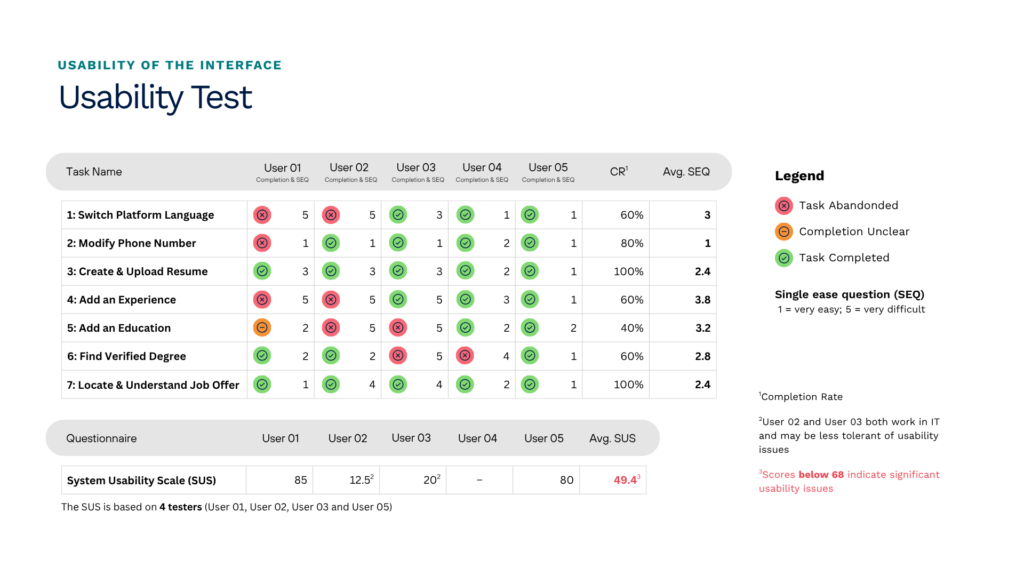
We also ran Usability tests and gathered our findings to identify key patterns. After each question, participants answered a SEQ questionnaire, and a SUS questionnaire was completed after task completion.
We gathered insights into an affinity map and ranked the issues by priority to help the client follow a clear roadmap.
Insights
The User interviews revealed three key user goals and five major pain points in the application process.
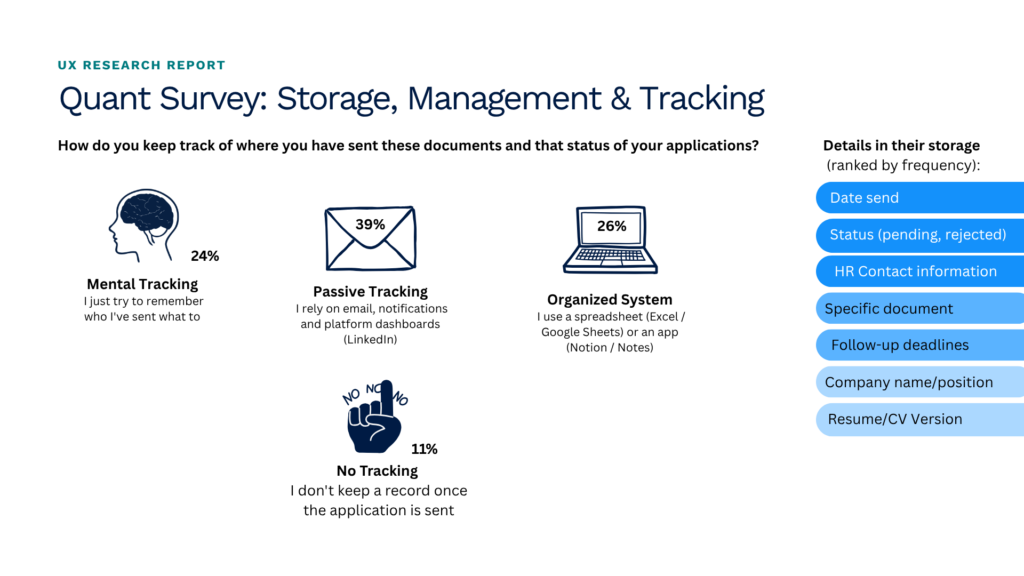
Two critical issues emerged across both the survey and interviews:
- Participants lack a structured system to track their applications and their professional documents are dispersed across multiple platforms. This fragmentation creates friction, particularly when users need to quickly access and submit documents under time pressure.
- Key concerns included the difficulty of showcasing current and transferable skills, especially in the context of increasing career transitions, as well as a strong need for transparency and control over personal data.
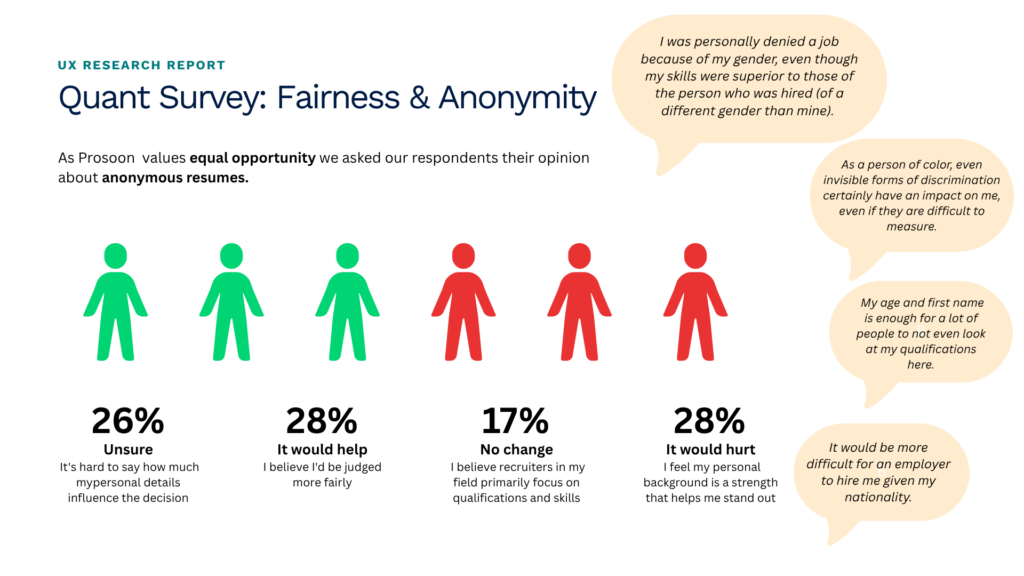
As Prosoon plans to value anonymous resumes, we explored user perceptions of this feature. Responses were divided: while some participants perceived anonymity as a limitation, others identified it as a potential advantage.
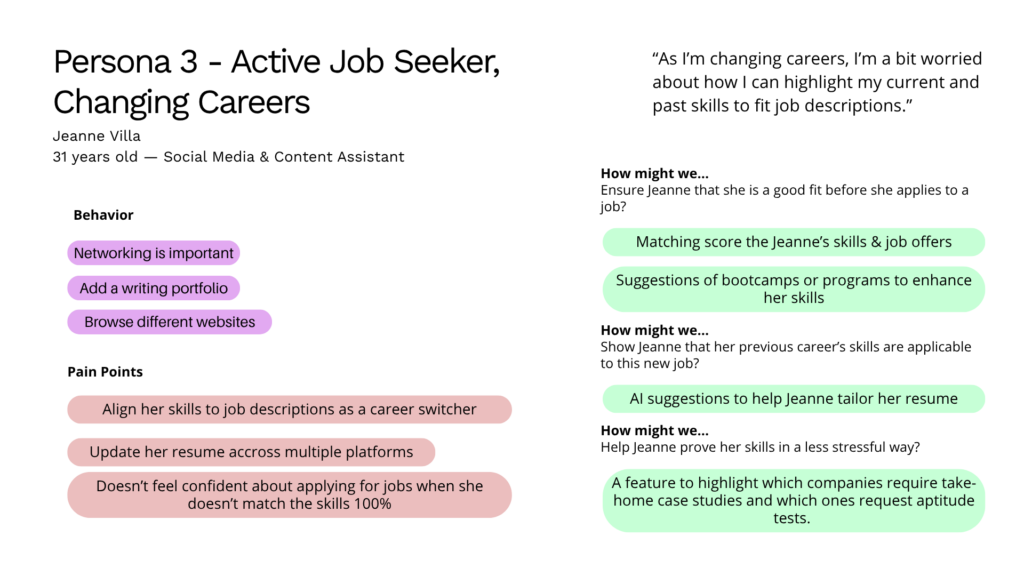
The interviews gave us valuable insights to create our Personas, Jobs to Be Done and How Might We to highlight more insights.
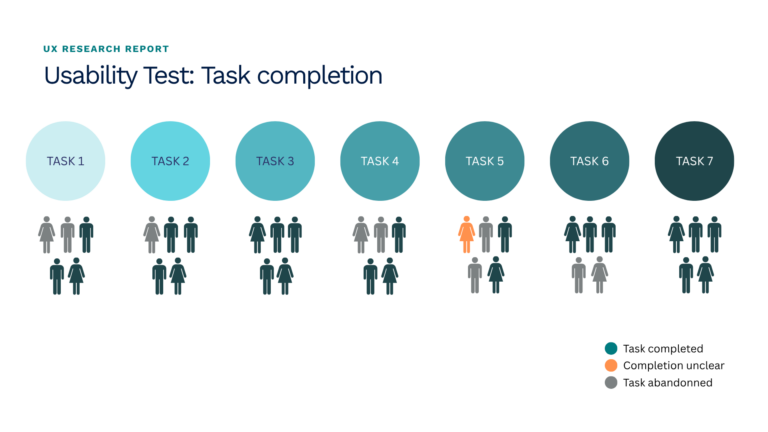
Following the usability test, the SUS score reached 49.4, indicating that the product suffers from poor usability.
Solutions & Outcomes
Thanks to the personas, we suggested:
- The platform could connect to different job boards to allow users to have all their documentation in the same place
- Provide a matching score between resumes and job offers
- Send notifications to help users stay informed
We identified 10 major fixes, with an impact-effort rating for each, so we suggested main findings and recommendations:
- Resume Builder Walk-Through, to offer step-by-step guidance. It could also include a split screen view. It would address the unclear user flow and make the form fields easier to understand.
- A PDF Parser would allow users to extract information from PDFs to make the process easier.
- Some technical issues need to be fixed, as they prevent the user from accomplish some basic tasks.
What I have learned & What I would improve
- The client refocused the project on law students during the process. We assumed that reaching out to a law University would be sufficient to recruit relevant participants for testing, but this approach proved too limited. If we were to redo the project, we would broaden our outreach strategy by contacting multiple universities to ensure a more reliable and diverse recruitment pool.
- Throughout the project, the distribution of tasks was uneven, which led to frustration within the team and difficulties in meeting internal deadlines. Task dependencies also created bottlenecks, increasing pressure on certain team members. Although communication was consistent, a more structured task allocation and better anticipation of dependencies could have helped balance the workload and prevent delays.
- During usability testing, we used a script but lacked a shared definition of what constituted task completion. This led to inconsistencies in how results were interpreted. We should have defined clear and detailed success criteria for each task beforehand to ensure consistency in data collection and analysis.
Tools: Miro (research and mapping), Zoom (video recording), Canva (Visual Assets)