Prosoon Platform
UX Research & Audit
Prosoon is a platform connecting employers, educational institutions and training providers, and students and job seekers. It combines a job board with digital credentials, allowing users to access and showcase their qualifications online, while helping employers identify relevant skills and connect with potential candidates.
As part of a five-person team during my Master’s degree, I was one of the two main contributors to the evaluation of its three digital interfaces. My work included competitive analysis, expert review, user research and usability testing, helping identify usability issues and opportunities for improvement.
01 PROJECT OVERVIEW
Prosoon is a platform that combines digital credentials and a job board. It aims to connect three main audiences:
Institutions: Uploading authentic digital badges and degrees.
Employers: Publishing job offers.
Students & Job Seekers: Showcasing their skills and making their qualifications verifiable to support their job search.
The project focused on understanding the needs of students and job seekers, evaluating the usability of Prosoon’s platform and identifying opportunities for improvement.
As part of a five-person team, I was one of the two main contributors. My responsibilities included competitive analysis, expert review, contributing to user research and usability testing, moderating interviews, recruiting participants, analysing findings and creating data visualisations for the final report.
Research at a Glance
Research Methods
- Qualitative user interviews
- Bilingual online survey (French & English)
- Task-based usability testing
Participants
- 5 testers
Research Frameworks
- User Personas
- Jobs to Be Done (JTBD)
- How Might We (HMW)
The research explored job seekers’ behaviours, expectations and challenges throughout the job application process.
02 COMPETITIVE ANALYSIS
Understanding the market
I began by analysing Credly, a platform specialising in digital credentials, to understand how qualifications and achievements can be represented and verified online.
I then compared three job boards: Grimp, LinkedIn and Indeed. The analysis focused on their main features and the opportunities they offered to students and job seekers.
I created a comparative matrix covering 14 features, including access to job offers, application tracking, networking, weekly reports and the presentation of skills and achievements.
Key findings
The analysis highlighted opportunities for Prosoon to combine features that are often spread across different platforms.
In particular, the comparison revealed opportunities to:
Improve the presentation of skills and professional achievements.
Offer better tools for managing job applications.
Facilitate networking and access to professional opportunities.
Combine digital credentials with job-search services.
These findings helped identify potential differentiating features for Prosoon rather than simply reproducing what established job boards already offered.
03 EXPERT REVIEW
Evaluating the existing experience
I conducted an expert review of Prosoon’s platform and website based on Andrew Kucheriavy’s 15 Usability Impediments.
The evaluation focused on identifying interaction problems, unclear information and obstacles that could affect users’ ability to complete tasks.
I also carried out specific reviews of translation and microcopy to identify inconsistencies, unclear wording and opportunities to improve the interface’s clarity.
Severity and prioritisation
Each issue was classified according to its impact:
Low: Minor friction or cosmetic improvements.
Medium: Noticeable obstacles that affect the experience.
High: Critical issues that can prevent task completion or affect user retention.
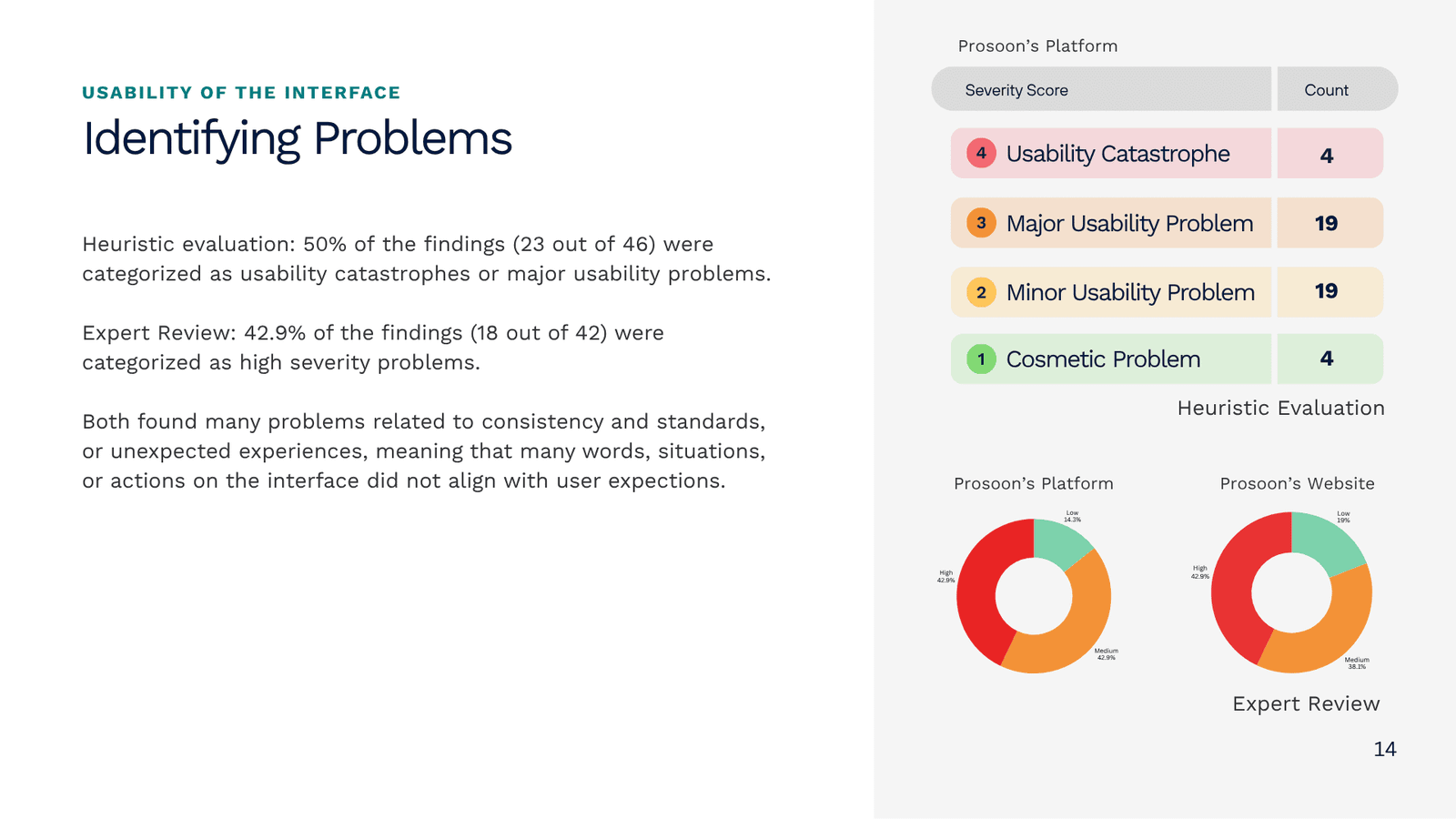
I created visual severity rankings for both the platform and the website, helping the team distinguish urgent problems from less critical improvements.
Main issues identified
The review highlighted several recurring problems:
Dead ends: Some interactions did not provide a clear next step.
Poor affordance: Certain elements did not communicate their purpose clearly.
Confusing information architecture: Navigation and information could be difficult to understand.
Missing confirmation messages: Users did not always receive clear feedback after an action.
Translation and microcopy issues: Some wording created confusion or reduced clarity.
I translated these findings into concrete recommendations, including clearer language selection, improved sign-up navigation, more visible search filters and better interaction feedback.
Key Evaluation Results
Heuristic Evaluation
23 out of 46 findings (50%) were classified as usability catastrophes or major usability problems.
Expert Review
18 out of 42 findings (42.9%) were classified as high-severity issues.
These results highlighted significant usability challenges across both the platform and its website, helping the team prioritise areas requiring improvement.
04 UX RESEARCH & USABILITY TESTING
Understanding users’ needs
The research phase combined qualitative and quantitative methods. As a team, we conducted user interviews and created a bilingual French and English questionnaire to explore job seekers’ behaviours, expectations and difficulties.
The research focused particularly on how people manage applications, organise professional documents and present their skills when looking for work.
I contributed to the interviews, participant recruitment, usability testing and analysis of the collected data.
Key insights
The interviews and survey revealed several important themes:
1. Fragmented application management
Participants described difficulties tracking applications and managing professional documents across different platforms. This highlighted the need for a more centralised experience.
2. Difficulty showcasing skills
Users, particularly those considering a career change, expressed concerns about demonstrating transferable skills and making their experience relevant to different job opportunities.
3. Fairness and anonymity
The research also explored perceptions of anonymous applications and personal data visibility. While some participants saw anonymity as a way to reduce discrimination, others questioned its limitations.
From Research to User Needs
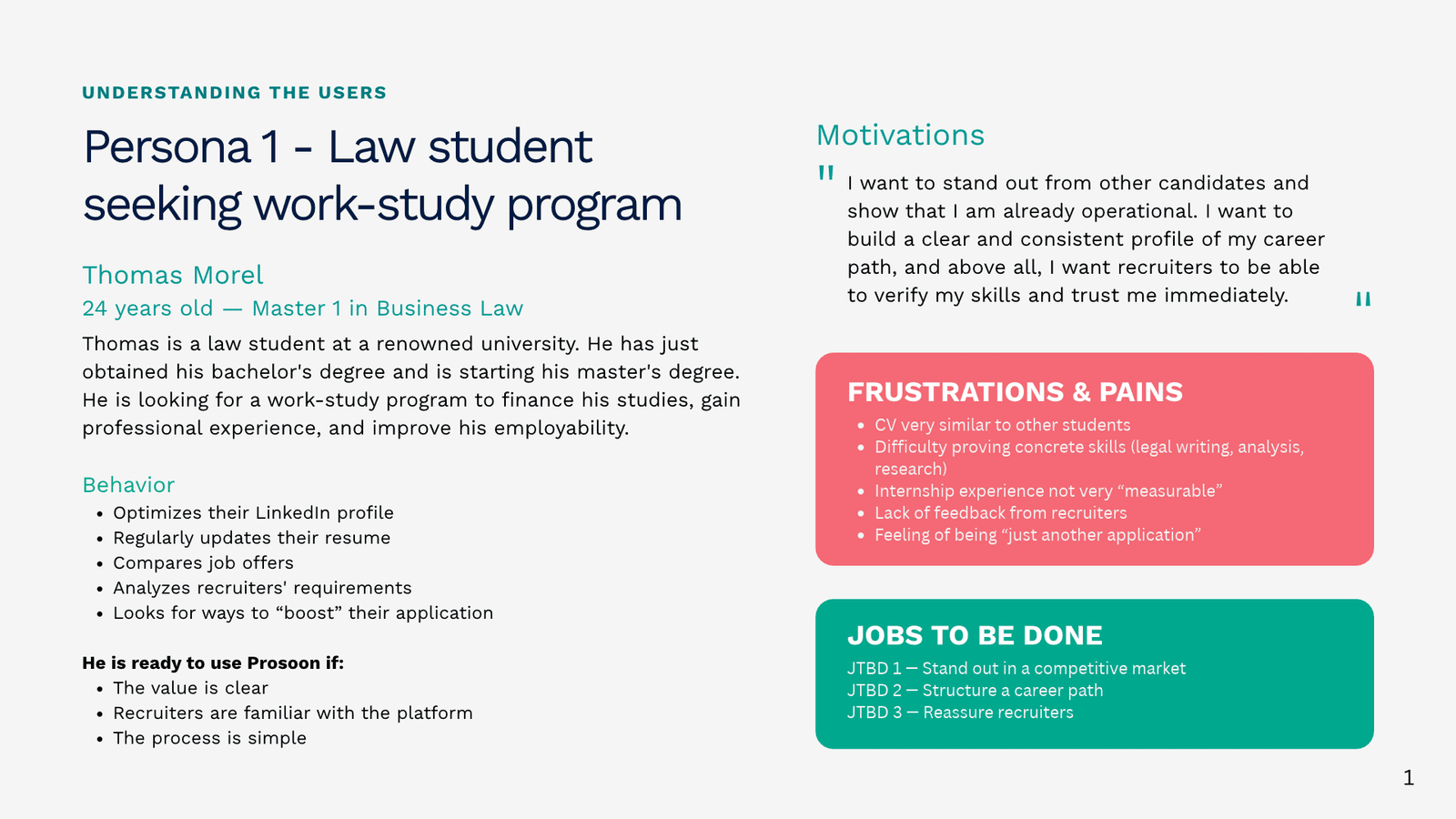
These findings were translated into user personas, Jobs to Be Done and How Might We statements. This helped the team move beyond individual observations, identify recurring user needs and turn research insights into actionable design opportunities.
Usability testing
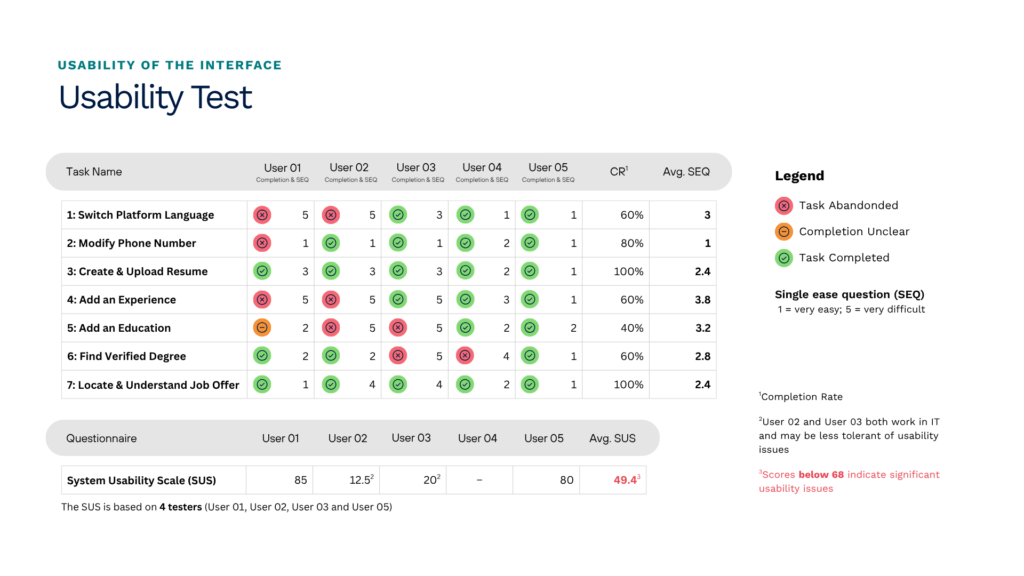
We conducted task-based usability tests to evaluate the existing experience and identify obstacles in key user journeys.
The results were analysed through task completion, completion issues and the System Usability Scale (SUS).
The platform received a SUS score of 49.4, indicating poor perceived usability and highlighting the need for improvements. The SUS score was calculated based on 4 participants, as one response was submitted after the analysis deadline.
The testing also helped identify friction points in navigation, task execution and the clarity of certain interactions.
05 SOLUTIONS & RECOMMENDATIONS
By combining competitive analysis, expert evaluation and user research, we developed a set of recommendations for Prosoon.
The main proposals included:
Connect different job boards: Allow users to centralise their job-search activity and professional documentation.
Improve skills matching: Help users identify relevant opportunities based on their experience and transferable skills.
Simplify the application process: Introduce clearer navigation, better search filters and a more guided sign-up experience.
Improve transparency: Make information about personal data, anonymity and profile visibility easier to understand.
Strengthen usability: Address high-severity issues and improve feedback, affordances and interface wording.
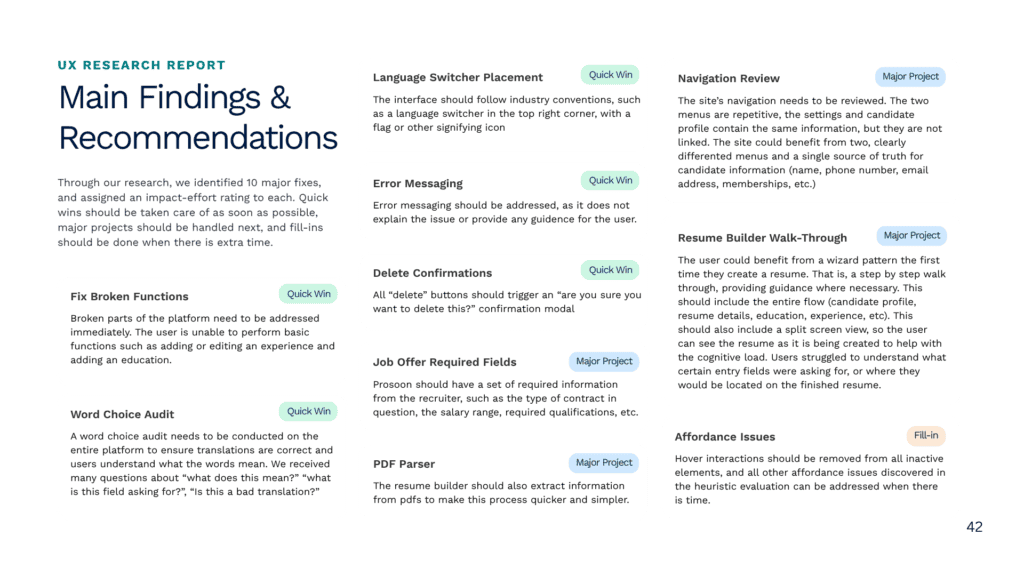
The audit also identified ten major usability issues, which were prioritised according to their impact and the effort required to address them.
These recommendations were intended to provide the client with a clearer roadmap for future improvements.
Project Deliverables
Competitive analysis comparing three job boards across 14 features.
Expert usability review based on Andrew Kucheriavy’s 15 Usability Impediments.
UX research report including user interviews, survey findings, personas and prioritised insights.
Usability testing report with task completion analysis and SUS results.
Comprehensive strategic audit and prioritised recommendations (120+ pages).
06 WHAT I LEARNED
This project gave me the opportunity to combine several UX methods within a collaborative project, from competitive analysis and expert evaluation to interviews and usability testing.
It also taught me the importance of distinguishing between different sources of evidence and turning a large amount of research into clear, prioritised recommendations.
One of the main challenges was coordinating work across a five-person team, managing dependencies and maintaining consistency throughout the research and reporting process.
Looking back, I would define more precise testing criteria from the beginning and broaden participant recruitment to obtain more diverse feedback.
Project outcome: A comprehensive strategic audit and a set of prioritised recommendations for Prosoon.
"We had the pleasure of working with Marion and her colleagues as part of the CAWEB Master's programme on the UX/UI of our three interfaces.We were particularly impressed by their professionalism, the relevance of their recommendations and their international perspective.They clearly identified areas for improvement and presented them with great insight. It was a high-quality collaboration that we highly recommend."
Hugo Spiess, CEO & Cofounder of Prosoon
Credits. The hero image was generated with AI tools.
I’m travelling in Southeast Asia from December 2026 and looking for a UX/UI or UX research role in the region.
Let’s grab a coffee!
Or write to marion.hulot@gmail.com