Ramakien Murals
Experience Design
The Ramakien murals at Bangkok’s Grand Palace tell a complex epic that visitors unfamiliar with the story struggle to follow. I designed a mobile app concept to explore them on-site and remotely, based on museum UX analysis, proto-personas and benchmarking. Prototypes were reviewed through AI-assisted simulations; testing with Thai visitors is the next step.
- Problem: Visitors to Bangkok’s Grand Palace often struggle to follow the story told by the Ramakien murals.
- My role: Solo UX researcher and UX/UI designer: audit of two museums (89 criteria, 5 proto-personas), benchmark, prototype in Figma.
- Tools: Figma.
- Outcome: A mobile app concept to explore the murals on-site and remotely, plus a card game. Not tested with users yet. Testing with Thai visitors is the next step.
RESEARCH
01 PROJECT OVERVIEW
In October 2024, I visited Bangkok’s Grand Palace and discovered the Ramakien murals, which illustrate the Thai epic of Phra Ram. Painted under King Rama I (r. 1782–1809), the epic was written down in 1797. However, understanding the characters, their relationships and the narrative as a whole can be challenging for visitors unfamiliar with the epic.
This inspired me to explore how a mobile app could bridge on-site discovery and remote exploration, offering visitors different ways to engage with the murals through their scenes, characters and symbols.
I began the project in summer 2025, then returned to it in March 2026. Building on my initial observations, I explored visitor needs and possible solutions through five research questions. In October 2026, I moved on to prototyping.


02 GOALS
Here are my four goals:
Make a complex visual narrative easier to explore.
Preserve the cultural depth of the Ramakien murals.
Take into account visitors’ different levels of knowledge, interests and needs.
Respect the sacred environment while offering an engaging digital experience.
03 METHODOLOGY
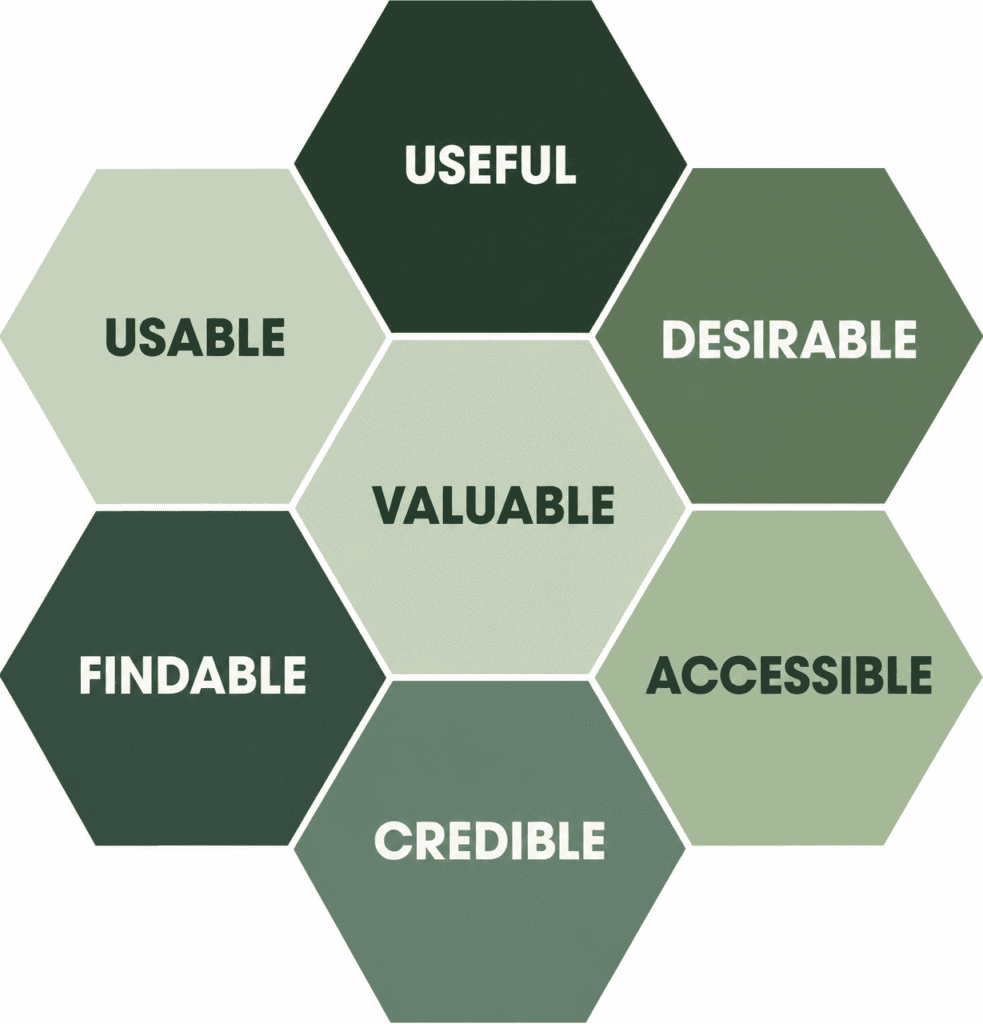
- Museums UX Analysis: Analysed the on-site and online experiences of the Rijksmuseum (Amsterdam) and Musée d’Orsay (Paris), using Peter Morville’s UX Honeycomb to identify their strengths and limitations.
- Proto-personas: Created five proto-personas based on the specific context of the Ramakien murals, representing different visitor profiles and needs.
- Proto-Persona-Based Museum Audit: Re-examined the Rijksmuseum and the Musée d’Orsay through the lens of each proto-persona, assessing whether their on-site and online experiences met their needs across each dimension of the UX Honeycomb.
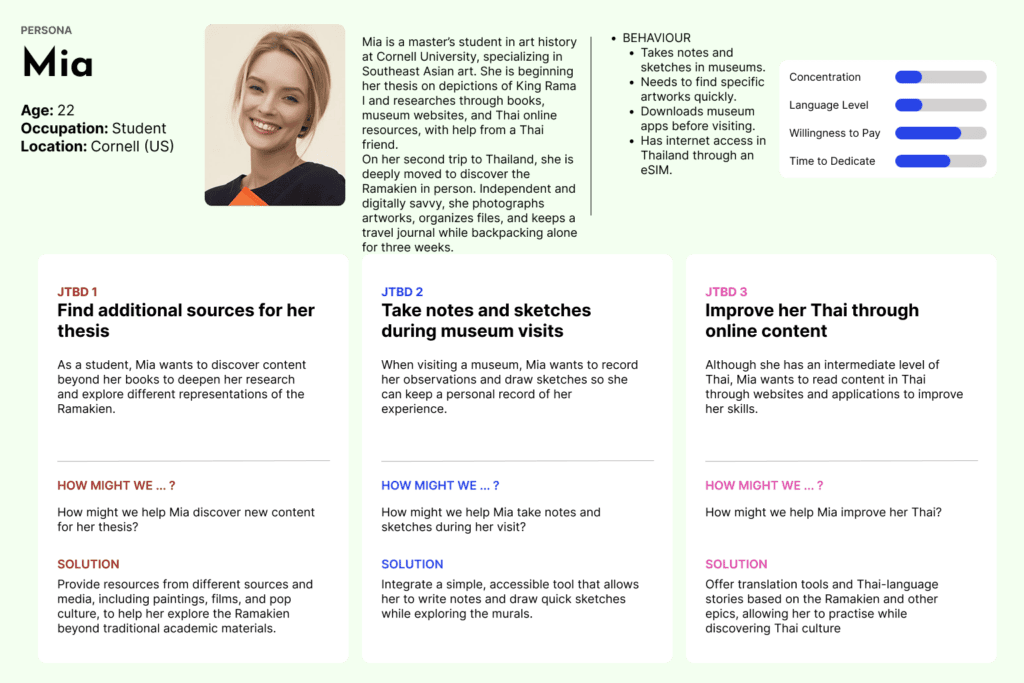
- JTBD & HMW: Used the insights from this analysis to identify design opportunities and formulate Jobs to Be Done and How Might We questions specific to the Ramakien murals.
- Cultural Experiences Benchmarking: Analysed existing culture apps & websites to explore relevant features and interaction patterns.
- Scenography: Explored immersive exhibition layouts to imagine new ways for visitors to experience the Ramakien murals.
- Wireframing & Prototyping: Translated the design opportunities into wireframes and high-fidelity prototypes, then explored key user journeys through AI-assisted usability simulations.
04 MUSEUMS UX ANALYSIS
To inform my project, I analysed the digital platforms and physical visitor experiences of the Rijksmuseum (Amsterdam) and Musée d’Orsay (Paris) using Peter Morville’s UX Honeycomb framework. Focusing solely on their websites would have provided only a partial picture.
First, I conducted an expert review of both museums using Peter Morville’s UX Honeycomb framework, assessing seven dimensions: usefulness, usability, findability, desirability, credibility, accessibility and value. To complement my analysis of their websites, I also watched several one-hour museum tour videos on YouTube to explore the on-site experience.
The Rijksmuseum offers a more exploratory and playful approach to discovering artworks, while the Musée d’Orsay follows a more traditional, encyclopaedic approach, organising its collections around artistic movements and techniques.
This initial comparison helped me identify different approaches to cultural mediation and explore how to balance open-ended discovery with structured access to information.

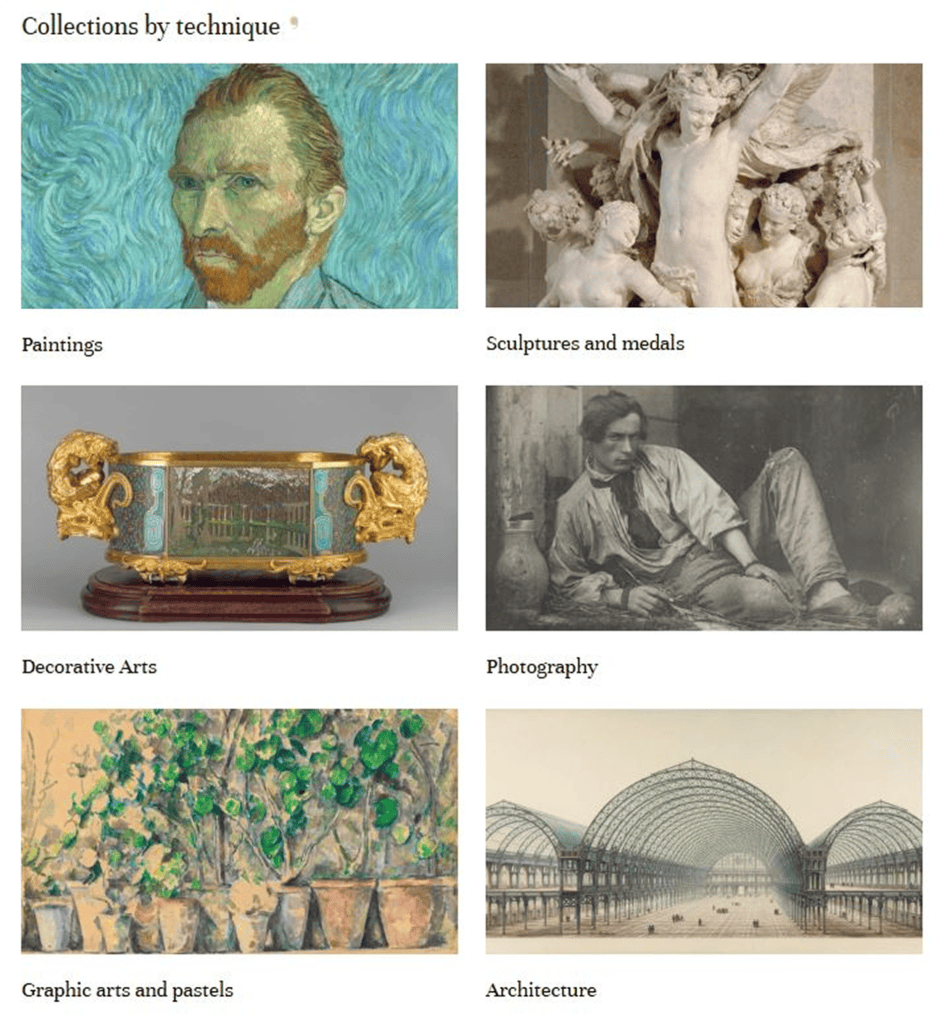
Rijksmuseum
Musée d'Orsay
05 PROTO-PERSONA-BASED MUSEUM AUDIT
Building on this previous analysis, I created five proto-personas based on the context of the Ramakien murals. I then revisited both museums’ on-site and online experiences (Rijksmuseum and Musée d’Orsay) to assess whether they addressed each persona’s needs, examining each dimension of the UX Honeycomb individually.
For each dimension of the UX Honeycomb, I evaluated how well specific needs were met using a scale ranking from Need not met to Need met, with Partially met and Not relevant as additional categories. I organised 89 evaluation criteria into the seven dimensions of Peter Morville’s honeycomb.
This second stage helped me identify which needs were addressed, where gaps remained and which opportunities could inform the design of a digital experience for the Ramakien murals.
06 JOBS TO BE DONE & HOW MIGHT WE
Focusing on the Ramakien murals, I used Jobs to Be Done (JTBD) and How Might We (HMW) frameworks to help me turn visitor needs and pain points into design opportunities.
JTBD helped me identify what visitors might want to achieve when engaging with the murals, while HMW questions helped me reframe these needs into features and solutions.
07 CULTURAL EXPERIENCES BENCHMARKING
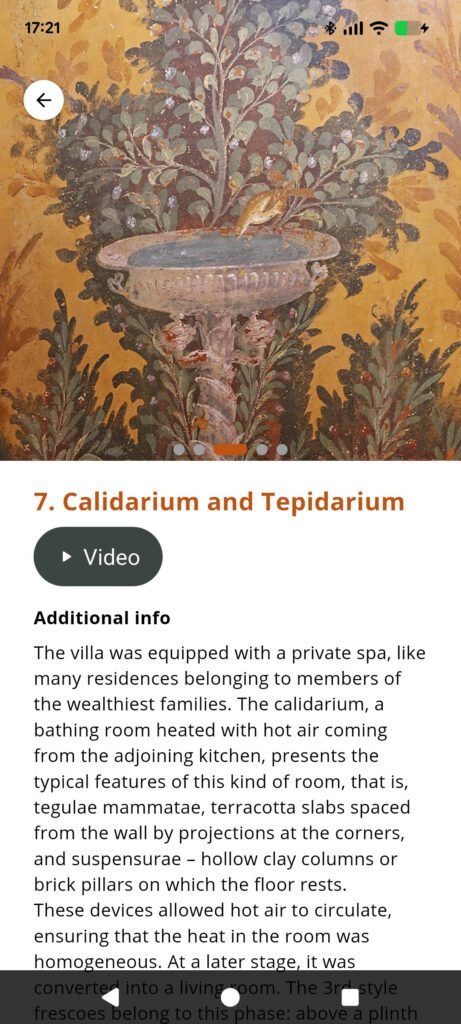
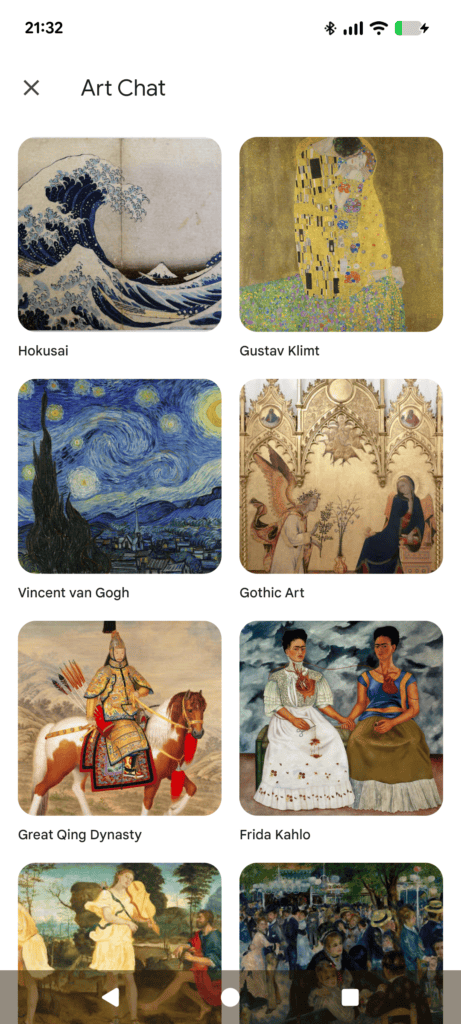
To explore how digital tools can support engagement with cultural heritage, I analysed three experiences: the Pompeii application, Google Arts & Culture and the Brancacci POV Experience.
I examined how they use storytelling, interactive features and accessibility tools to help users discover artworks and historical sites. The analysis highlighted opportunities for the Ramakien project, including maps, restoration information, gamification and experiences that encourage shared engagement.
I also identified technical limitations, such as connectivity issues, inconsistent display across devices and interfaces that don’t adapt to screen orientation. These considerations informed my thinking about both the features and practical constraints of the proposed application.
Pompeii App & Google Arts & Culture
DESIGN
08 INSIGHTS
- Consider accessibility from the start: Features such as subtitles, videos in sign language (according to the target language) and audio descriptions offer alternative ways to access content and accommodate different visitor needs.
- Multiple entry points: Thai and international visitors may need different entry points: Thai visitors may already know the epic and look for details and symbolism, while international visitors may need an introduction to the story and its characters. A survey could help assess Thai visitors’ familiarity with the Ramakien and identify their existing knowledge of the story.
- The experience should work beyond the museum walls: On-site visitors may have limited or no network access. Downloadable content and offline access can help ensure that the experience remains available throughout the visit.
- Different visitors need different levels of depth: While students and art enthusiasts may seek detailed information about artistic techniques, layers of the artwork and restoration processes, other visitors may prefer a more accessible, encyclopaedic overview. Search filters and interactive exploration can help users find the level of information that suits them.
- Immersion creates a richer experience: Visual storytelling and contextual content can help visitors connect with the artworks rather than simply read about them.
- Multiple formats encourage discovery from different perspectives: Audio guides, interactive features, games, podcasts and in-depth videos can offer complementary ways to explore cultural heritage, making the experience more engaging and adaptable to different interests.
- Content should work offline: Some visitors turn off mobile data abroad to avoid roaming charges, and connections can be unreliable on-site. Downloading content in advance keeps it accessible and reduces data use. (To validate: visitors’ data habits and on-site connectivity.)
09 SOLUTION
I designed a mobile app concept that offers two main complementary ways to explore the Ramakien murals.
- Explore the Murals connects the physical artwork with an immersive digital experience, available on-site or remotely. Users can explore the murals, access related content, listen to audio guides and examine artistic details.
- Browse the Ramakien provides a structured way to discover scenes, characters and symbols. Search, filters and dedicated content pages help users find specific information about the scenes, characters and symbols, and explore the story in greater depth.
Additional features, including favourites and personal notes, allow visitors to save discoveries and return to them later. The experience also includes practical visit information and ticket booking.
Multimedia content, including audio guides, videos and podcasts, provides additional ways to engage with the story.
Accessibility was considered in both the app prototypes and the proposed immersive exhibition spaces. The interface is intended to be available in Thai and English. Visitors can prepare their visit before arriving by downloading content based on their interests, so the experience remains available without mobile data on site.
The aim is to give visitors different ways to engage with the same artwork, from a quick introduction to a more detailed exploration.
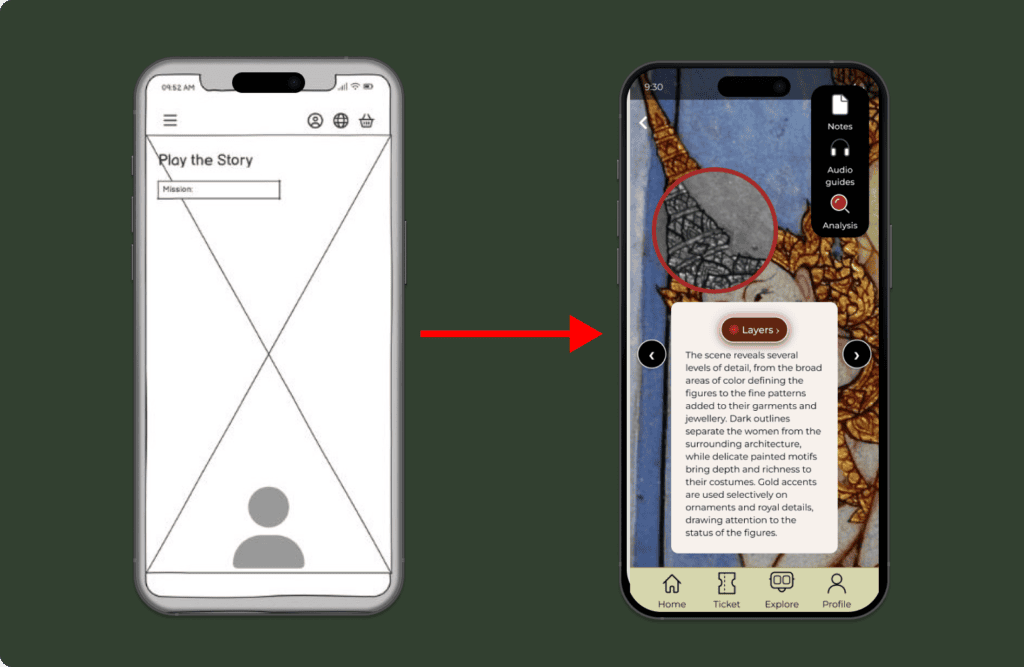
10 WIREFRAMES
My initial wireframes helped me explore different ways to organise the content and connect the physical murals with digital mediation.
As the project developed, I revisited the information architecture, refined the navigation and reconsidered earlier design decisions (such as QR codes to explore the murals). QR codes could not be placed directly on the palace walls. This led me to explore image recognition as an alternative, allowing visitors to access information about the murals without placing markers on the artwork.
For instance, first I explored the idea of allowing visitors to embody a character from the Ramakien to experience the story from a different perspective. However, I questioned whether this approach might shift visitors’ attention towards their own character and in-game actions, rather than the murals themselves.
Since the primary goal is to help visitors understand and engage with the artworks, I chose to prioritise direct exploration of the murals. Interactive elements and storytelling should guide visitors through the scenes, characters and symbols, enriching their understanding without distracting them from the artwork.
This allowed me to create a more coherent experience, with clearer entry points and more consistent interactions.
11 SCENOGRAPHIES
I explored three exhibition layouts to rethink how visitors could experience the Ramakien murals beyond their traditional linear presentation. These concepts could be experienced through a VR headset, allowing visitors to explore a virtual space as if they were physically standing in front of the murals, or adapted to real spaces through immersive projections.
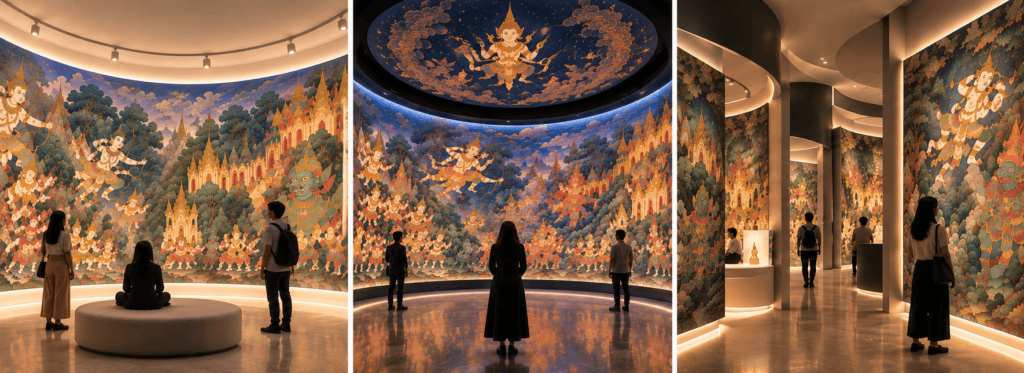
AI-generated visualisations
Semicircular Layout: An open, panoramic space that allows visitors to view a large section of the mural at once. This configuration encourages a broad overview of the narrative while maintaining an open and accessible environment.
Circular Layout: An enveloping space that surrounds visitors with the mural, creating a stronger sense of immersion. The continuous visual environment could encourage visitors to explore the narrative progressively and experience the artwork from different viewpoints.
Labyrinth Layout: A sequence of curved pathways and mural-covered partitions that reveals scenes progressively. This configuration could encourage a more focused exploration of individual episodes, offering visitors a sense of discovery as they move through the space.
Moving away from a linear format opens up new ways to discover the narrative. A labyrinth-like layout could reveal the murals section by section, while other configurations could highlight specific scenes or characters. It could also provide additional layers of information, allowing visitors to explore details, symbolism and narrative elements directly within the mural environment.
By separating the digital experience from a fixed physical setting, these concepts could make the murals accessible in different venues and cultural contexts, offering opportunities for international dissemination without requiring the original murals to be physically present.
12 CARD GAME
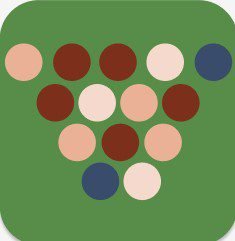
I explored a card game using geometric illustrations to help visitors discover the Ramakien story. It could be played physically, printed as a PDF or integrated into the app, offering different ways to engage with the content.
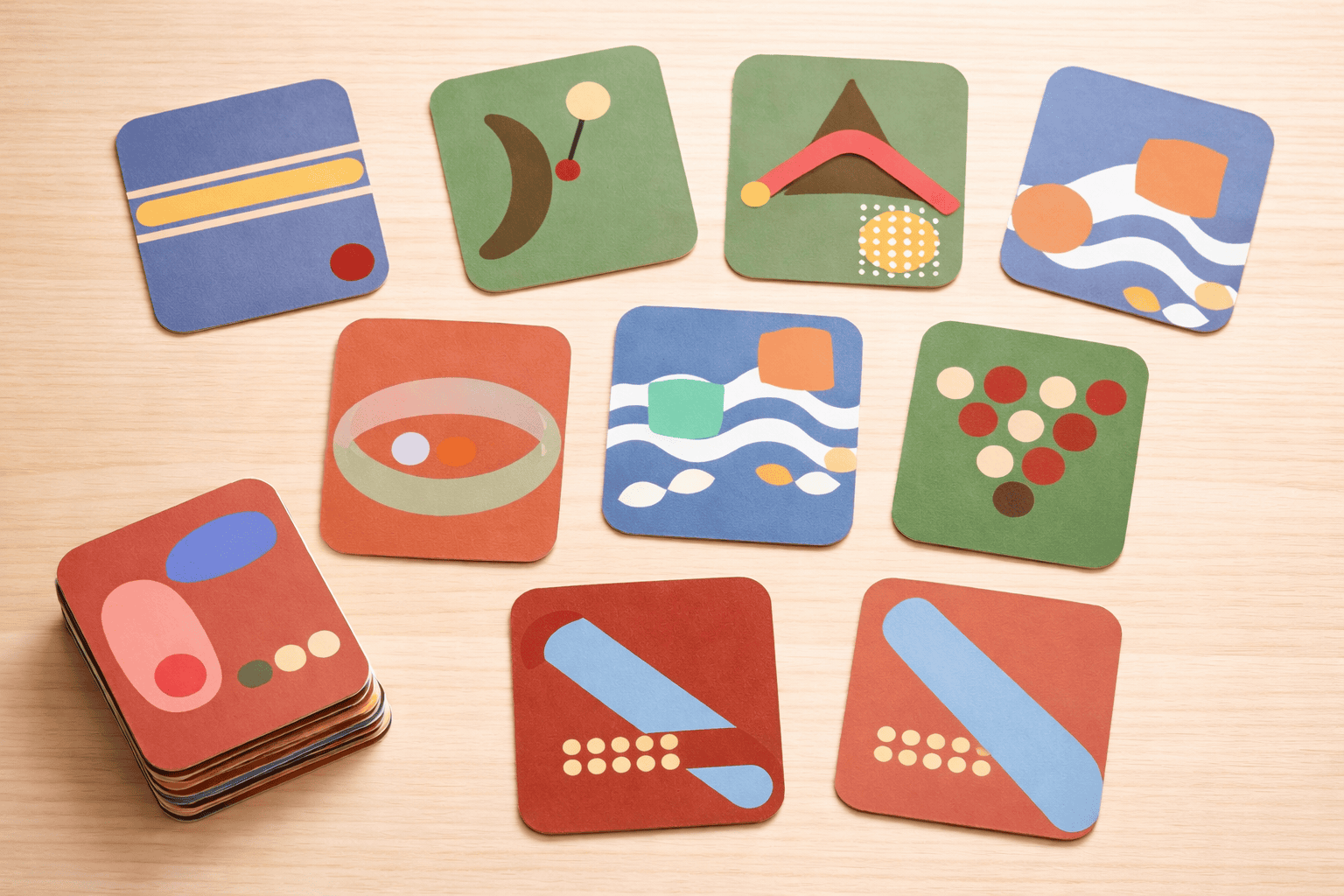
AI-generated visualisations
Why a game? One of my proto-personas, Aek, is a Bangkok accountant who may visit with his nine-year-old niece. He wants activities to keep her interested. Inspired by Google Arts & Culture, I explored how a game could make cultural discovery more engaging for children.
The idea. I turned scenes from the murals into simple geometric illustrations. Characters become coloured circles, while weapons, rivers and bridges are represented by lines and shapes. The goal is to help children recognise the scenes through a visual game.
Two possible game formats. The concept could take the form of a memory game or a matching game where children identify which mural scene corresponds to each illustration. It could be offered as a physical card deck, a printable PDF for classrooms, or a module within the app.
Next step. The concept has not yet been tested with children. I would test it with a few families and a Thai teacher to see which format is the most engaging and easiest to understand.

13 PROTOTYPES
Selected User Journeys
The following screens showcase selected user journeys and key features of the application. Rather than presenting every screen, I focus on a few representative flows to illustrate how users can discover, explore and engage with the Ramakien murals.
A - Explore the Murals
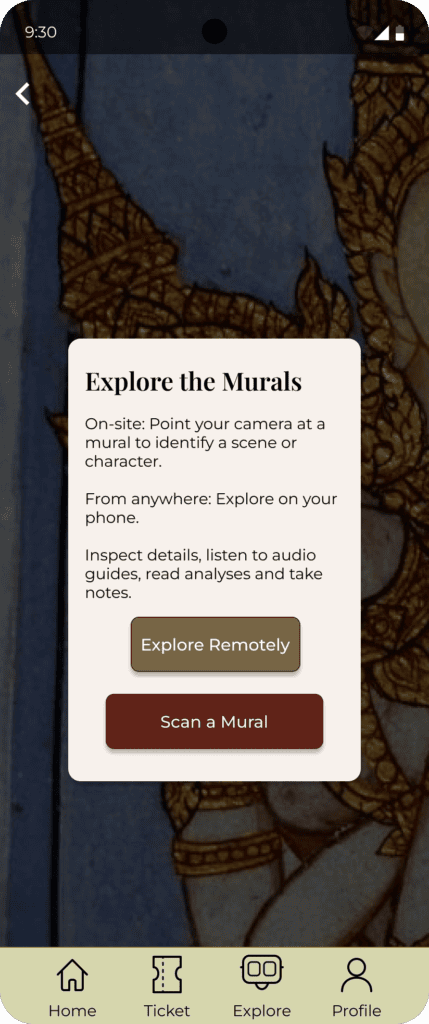
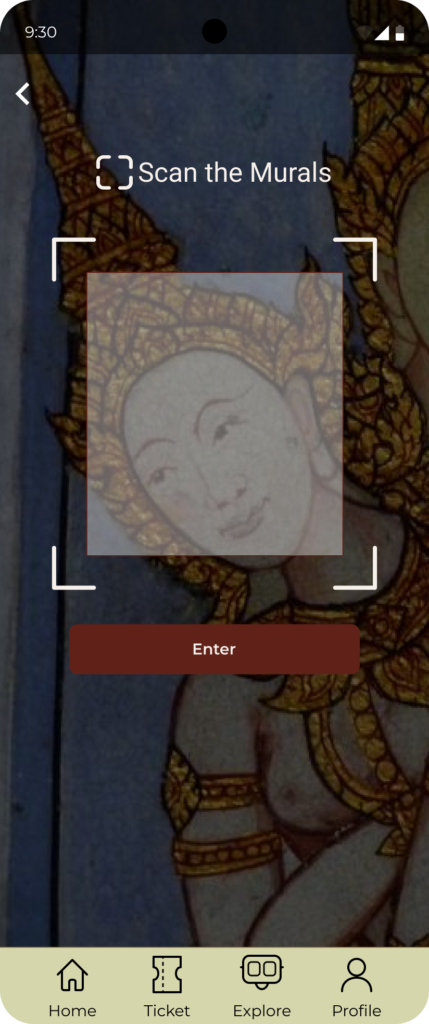
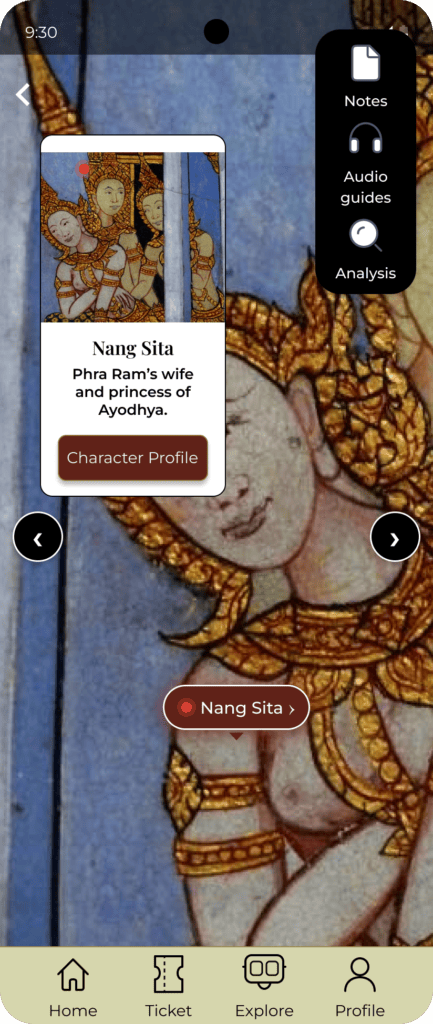
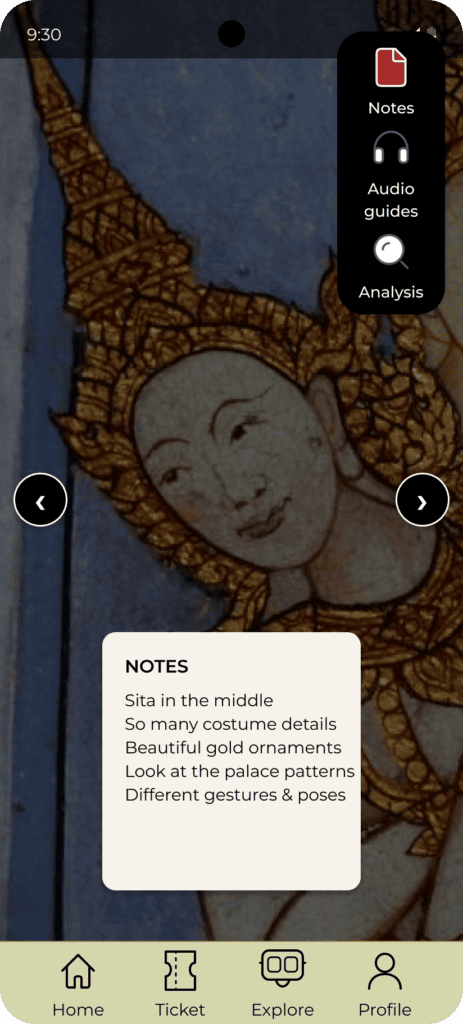
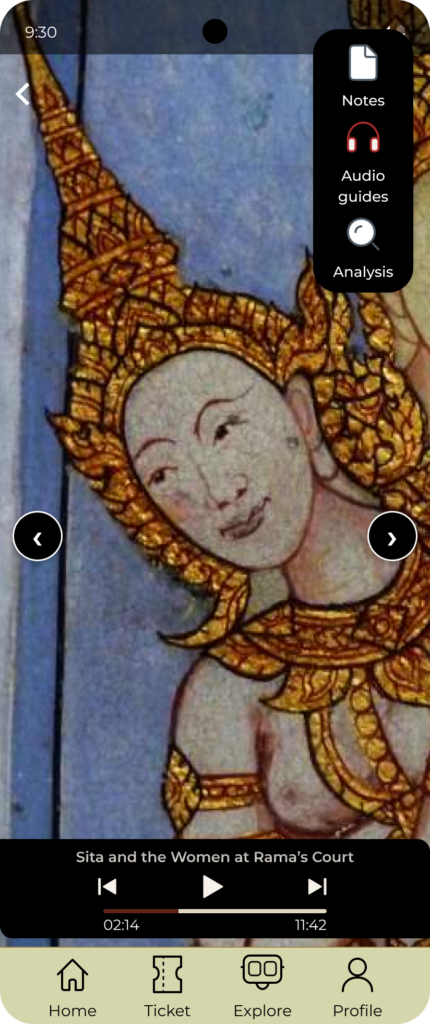
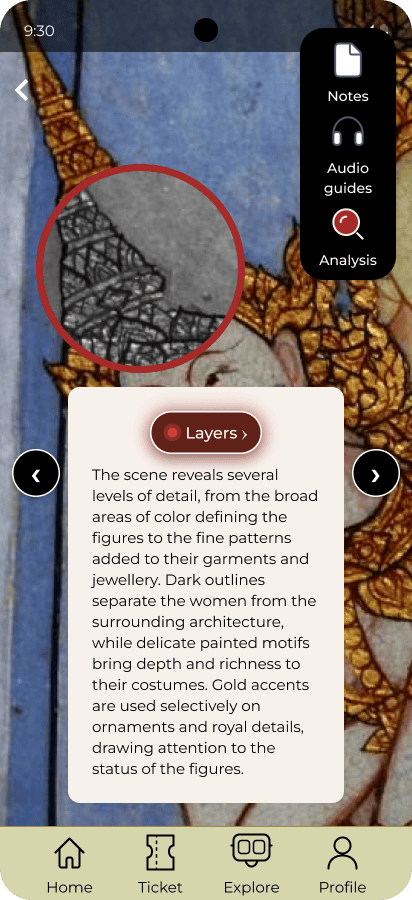
The app offers two ways to discover the Ramakien murals. Visitors can explore remotely from their phone or interact with the murals on-site by pointing their camera at a scene or character.
Both experiences give users access to additional content, including detailed views, audio guides, analyses and notes, allowing them to explore the murals at their own pace.
B - Browse the Ramakien
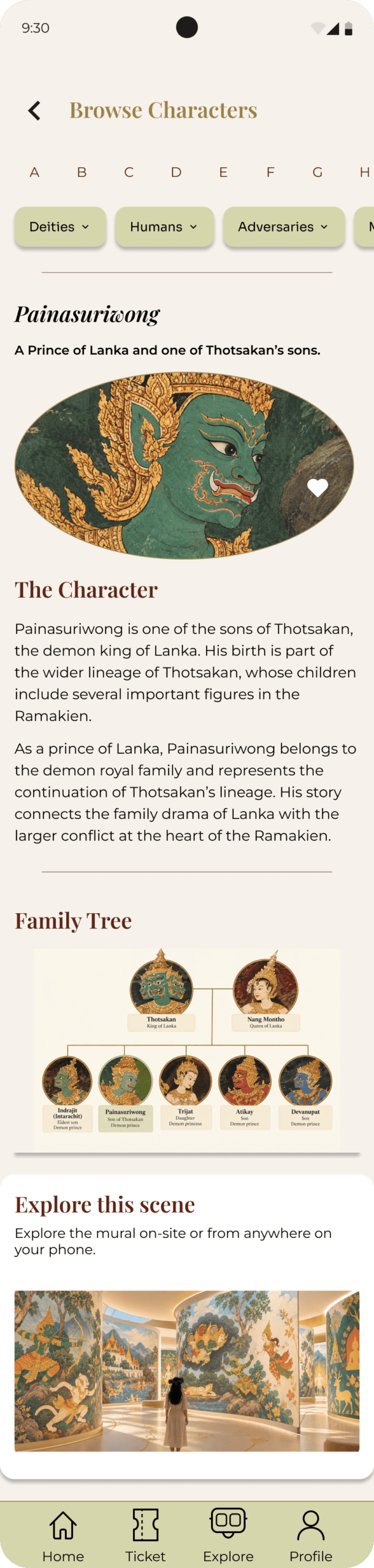
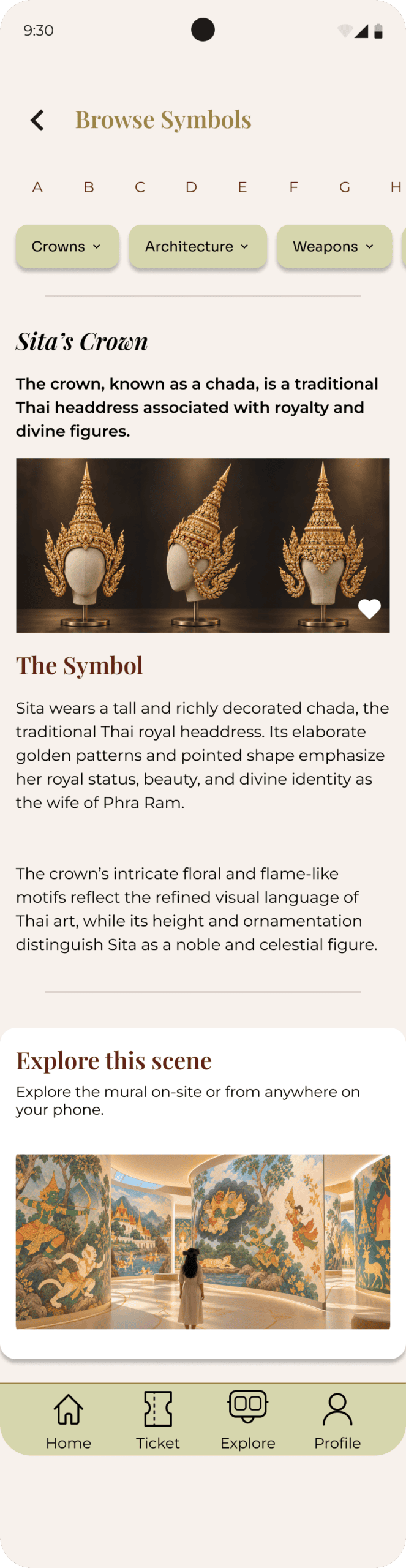
Users can browse scenes, characters and symbols through alphabetical lists or filters. A dedicated section also introduces the main characters and their family relationships through a genealogical tree.
From there, users can access a specific scene, character or symbol directly through Explore the Scene to examine the artwork in greater detail and discover its context, symbolism and narrative

C. Plan the Visit & Booking
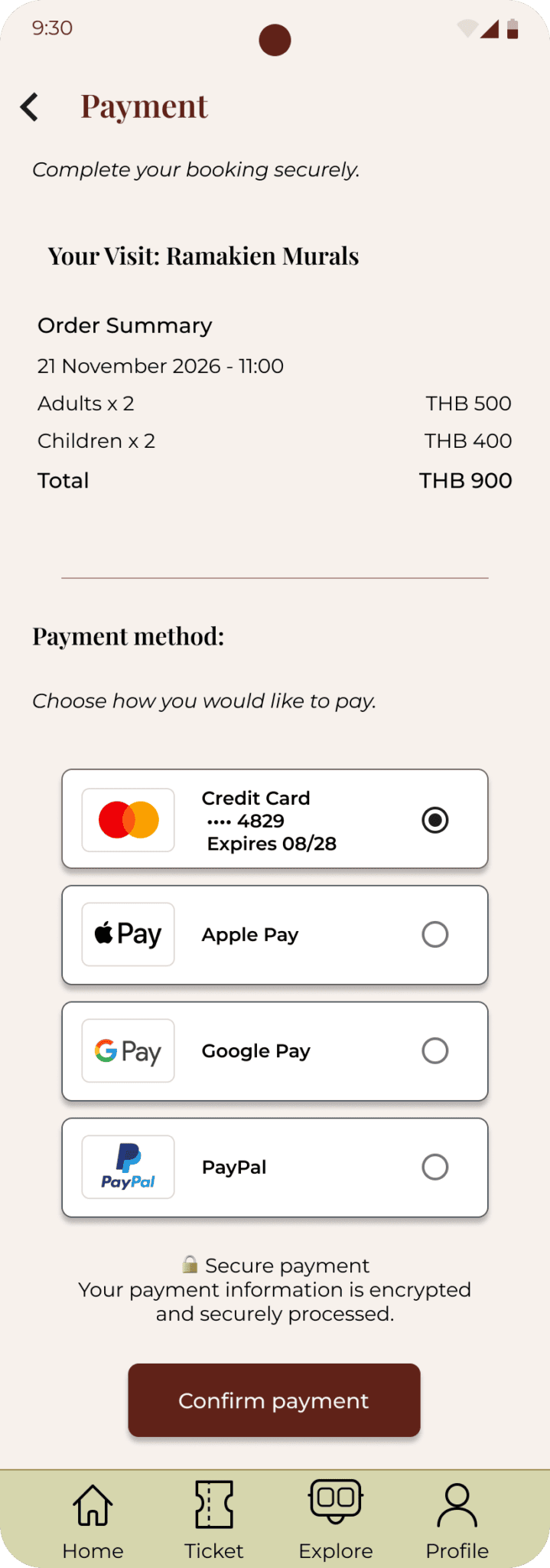
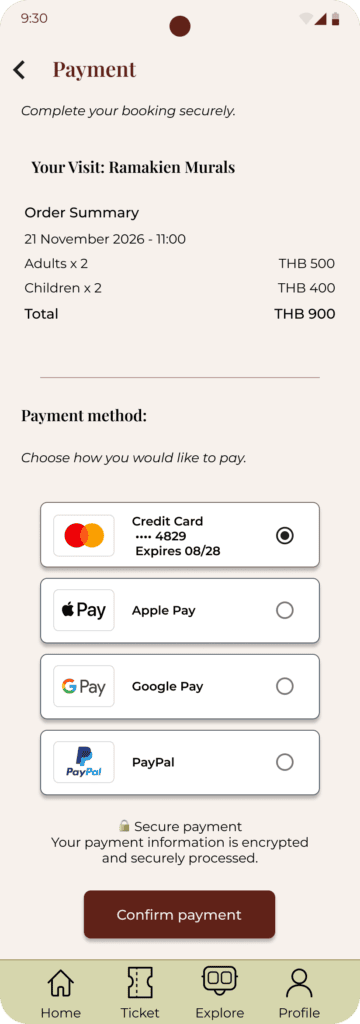
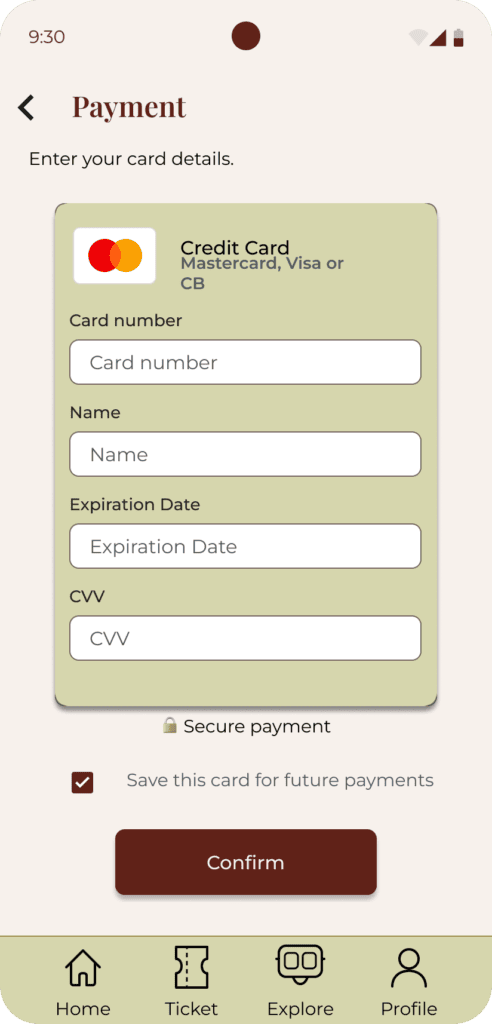
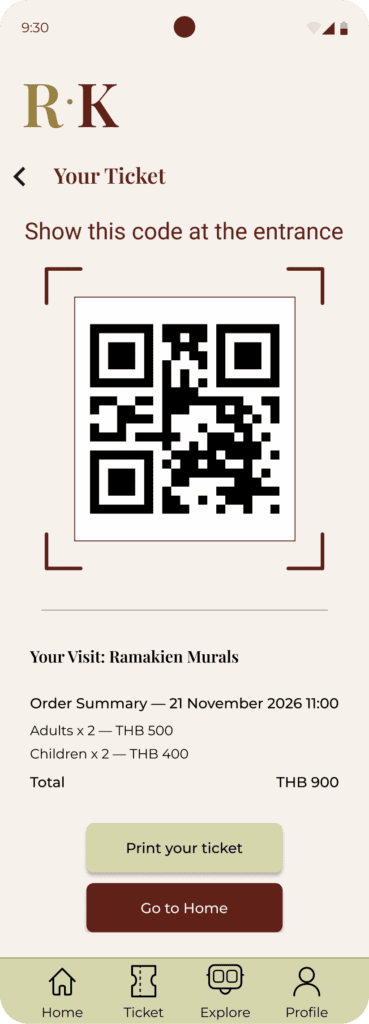
Users can plan their visit and book tickets directly through the app. They select a date and time slot, choose the number of visitors by category, and review their booking summary before proceeding to payment.
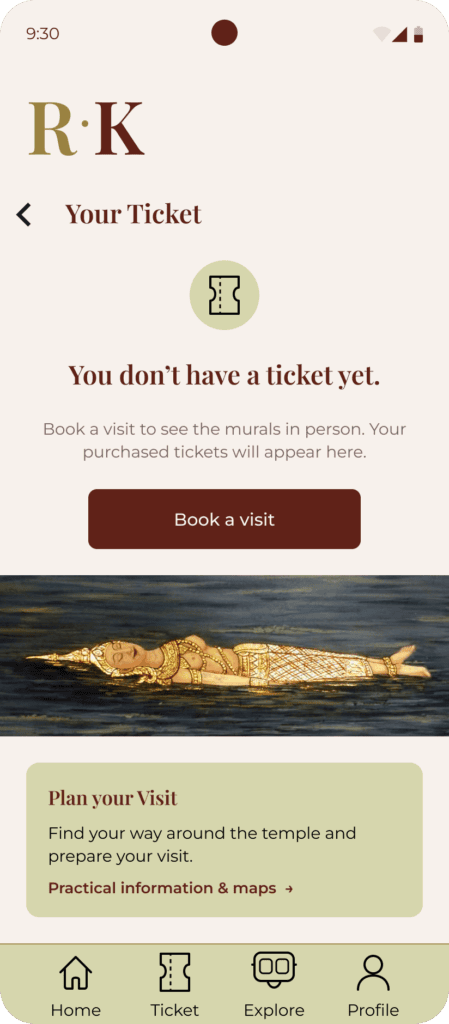
The payment flow guides users through the selection of a payment method, provides security information, and confirms the outcome of the transaction. Once the booking is complete, users can access their booking details and digital ticket from the Ticket section, via the bottom bar or their profile.



D. Profile screen
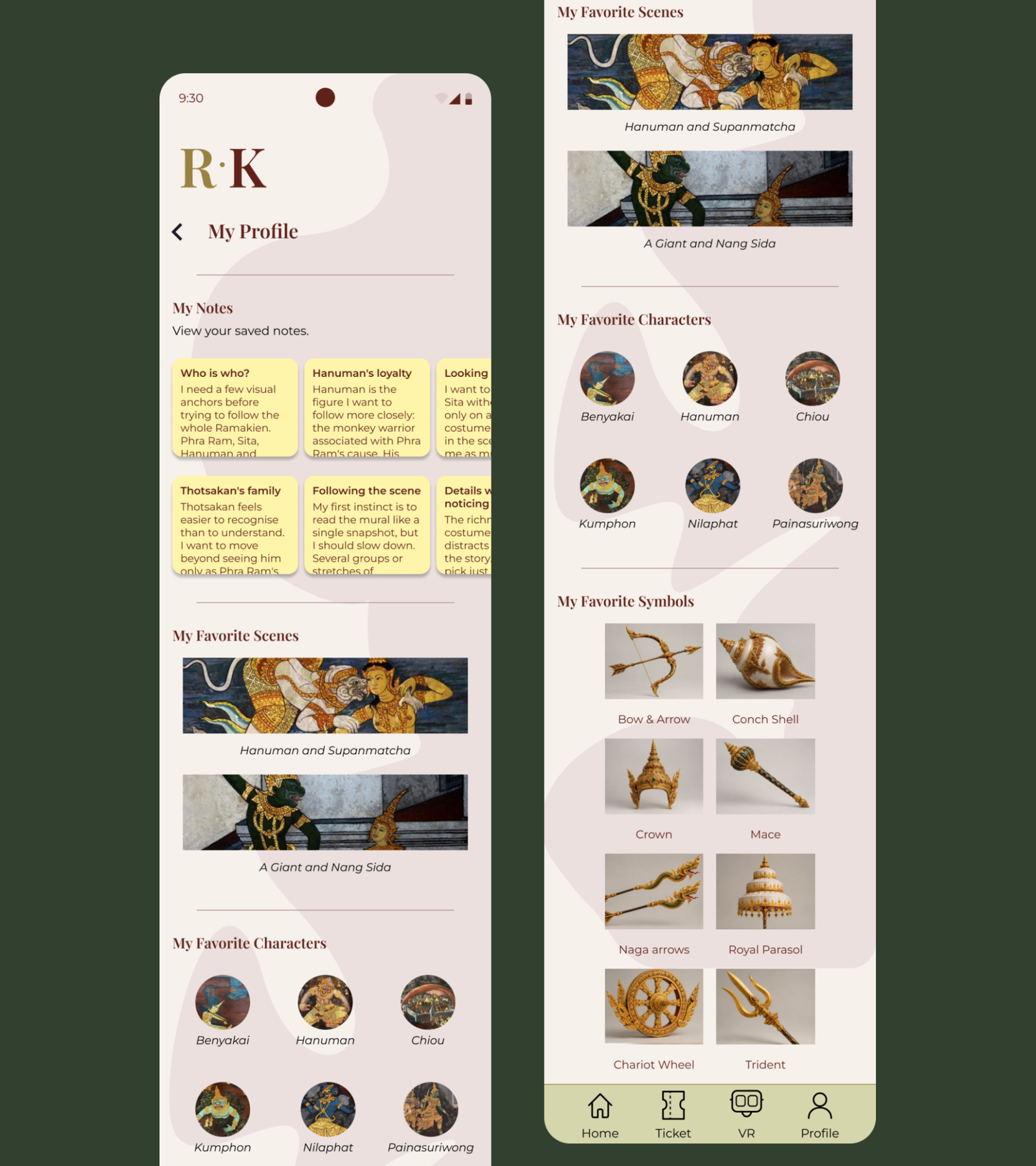
The Profile section brings together users’ saved notes and favourite scenes, characters and symbols. It provides a personal space where they can revisit the information they have saved and easily return to the corresponding content.
This allows users to keep track of the scenes, characters and symbols that interest them throughout their exploration of the Ramakien murals.
REVIEW & NEXT STEPS
14 AI-ASSISTED USABILITY REVIEW
No user testing has been conducted.
I used AI-assisted simulations across six task scenarios to challenge my design assumptions and identify potential usability issues. These highlighted possible friction points in the ticketing flow, particularly around finding the entry point for purchasing a ticket and distinguishing between accessing an existing ticket and booking a visit. They also suggested potential confusion between podcasts and audio guides.
In response, I redesigned the ticketing entry point by creating a dedicated screen with two clear options: access an existing ticket or book a visit. The interface indicates when users do not yet have a ticket, helping them understand which action to take. Both options are also accessible through the bottom navigation bar. I also refined the interface to make the distinction between podcasts and audio guides clearer.
15 LIMITATIONS
These iterations aim to reduce user uncertainty and create a more intuitive experience. However, the issues identified through AI-assisted simulations remain hypotheses rather than validated usability findings. Testing with real users, including Thai visitors, is an important next step to assess the effectiveness of these design changes, evaluate the overall user experience and explore the cultural relevance of the content.
This project relies on hypotheses and AI-assisted simulations. For examples of research with real users, see Prosoon, Glossa: Language Learning App or my Master’s Thesis.
16 MEASURING SUCCESS
I identified three potential KPIs to evaluate the experience after implementation:
Ticket conversion: Track the impact on ticket purchases.
Offline downloads: Measure content downloads.
Customer Satisfaction Score (CSAT): Assess visitor satisfaction.
These metrics are proposed for future evaluation; no results have been collected yet.
17 WHAT I WOULD DO DIFFERENTLY
What I Would Improve: If I were to revisit this project, my first priority would be to conduct interviews and usability tests with Thai visitors. This would help me better understand their expectations, question my own cultural assumptions and ensure that the experience respects the cultural significance of the murals.
I would also test the app with international visitors with different levels of knowledge of the Ramakien, to understand how their backgrounds influence their experience.
I would further adapt the interface to local mobile usage patterns, paying particular attention to intuitive navigation and connectivity. I would also investigate whether the artwork recognition technology is feasible and test the app in the actual environment, where sunlight, internet access, movement and accessibility can affect how visitors use their phones.
Finally, I would incorporate more insights from Thai cultural mediation practices to better balance my perspective. I would also consider local habits and expectations, including QR code payments through PromptPay, formal language and Thai text formatting.
What I Learned: This project allowed me to explore the UX process, from research to prototyping, and to approach a culturally significant subject with care, curiosity and respect. I was particularly drawn to this project because it reflects my long-standing interest in Thailand and cultural narratives.
Credits. The hero image and some illustrations were generated with AI tools. Research, analysis, flows and interface designs are my own.
I’m travelling in Southeast Asia from December 2026 and looking for a UX/UI or UX research role in the region.
Let’s grab a coffee!
Or write to marion.hulot@gmail.com